
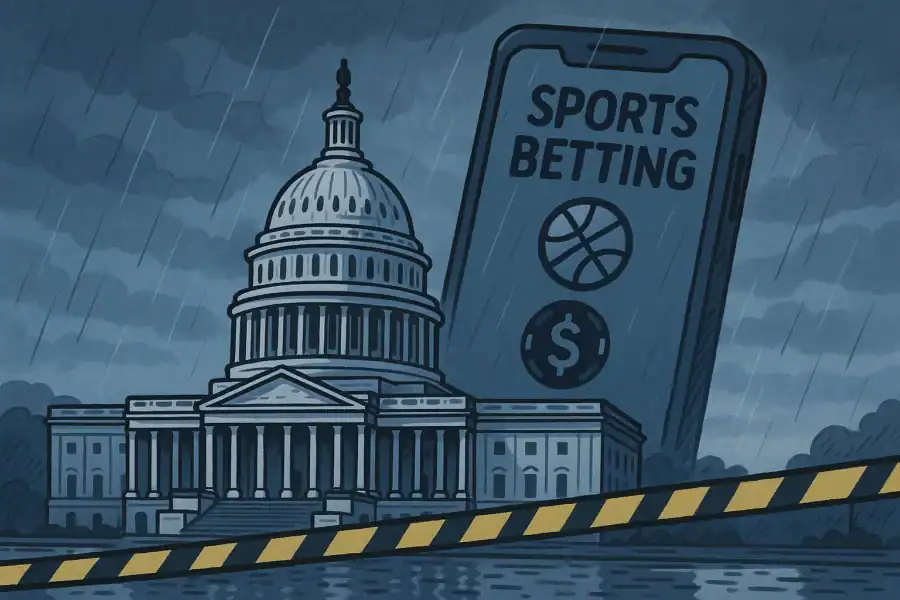
Sports betting apps are already raking in money from problem gambling, and they could soon benefit from a repeal of the federal sports betting tax.
In September 2025, U.S. Sens. Catherine Cortez Masto (D-NV) and Cindy Hyde-Smith (R-MS) reintroduced the WAGER Act, a bill to exempt legal sports betting from certain federal taxes.
Lawmakers want to repeal the federal 0.25% handle tax and the $50 per-employee “head” tax. These taxes apply to sportsbook operators, not people who bet on sports.
Sports bettors must pay taxes on winnings as income.
In the House, Rep. Dina Titus (D-NV) and Rep. Guy Reschenthaler (R-PA) introduced a companion bill seeking similar changes.
Supporters say repeal would help legal sportsbooks compete with illegal offshore sportsbooks. Critics urge that any change include funding for problem gambling services.
Betting addiction statistics show that over half of online bettors chase losses.
Explaining the Federal Sports Betting Tax
The Withdrawing Arduous Gaming Excise Rates (WAGER) Act would amend the Internal Revenue Code to the benefit of the sports gambling industry.
At two pages, it’s short and simple legislation.
The code would be revised to exempt state-authorized sportsbooks from the federal excise tax.
Specifically, the bill would remove both the 0.25% tax on handle and the $50 annual per-employee tax paid by legal sportsbooks.
Legislation to repeal the taxes and fees followed an earlier proposal in 2025 that had sought to divert the handle tax to pay for deportations. The GAMBLER Act died in Congress.
How Much Money is at Stake in Wager Act?
The Nevada lawmakers want to save Las Vegas casinos some money.
In Nevada, sportsbooks paid nearly $22 million in federal handle tax in 2022. The sportsbooks generated $446.7 million in revenue during the year.
The federal handle tax generated over $300 million in 2024.
The tax haul has surged in recent years, with the U.S. sports betting sector expanding to nearly $14 billion in revenue in 2024.
Why Supporters Want the Betting Tax Repealed
Sponsors argue the excise tax, first imposed in 1951, is outdated. They claim it penalizes regulated operators and advantages illegal offshore sportsbooks that don’t pay it.
Hyde-Smith also pointed to competitive pressure from out-of-state prediction betting sites. The leading prediction-style sports gambling platforms are Kalshi and Polymarket.
Tax and policy commentators have criticized the levy as a handle-based surcharge that doesn’t track profitability and adds cost to legal bets.
The American Gaming Association has supported efforts to repeal the handle tax.
However, the AGA and its members have put forth controversial estimates on the size of the illegal betting market.
What Problem Sports Betting Advocates Say
The National Council on Problem Gambling (NCPG) responded to the reintroduction of the WAGER Act in September 2025.
The NCPG, which suffered a court defeat over the 1-800-GAMBLER helpline, urged Congress to pair any tax change with dedicated federal funding for gambling addiction.
There are no federal dollars from the excise tax currently supporting problem gambling services.
The NCPG announced that it was neutral to the WAGER Act. However, the organization suggested that it preferred the handle tax remain in place. The NCPG had previously endorsed the GRIT Act.
“The federal sports betting excise tax is a longstanding revenue source supported across the political spectrum,” the NCPG, which receives gambling industry money, said in a statement.
“Dedicating a portion of this tax to help American families with problem gambling services would be the fairest and most cost-effective way for Congress to help states supplement prevention and treatment for their communities. If Congress chooses to adjust the tax rate on the gambling industry, NCPG recommends that any change be paired with a reciprocal commitment to fund prevention, treatment, and research to help those battling this life-threatening addiction.”
What Next for the Federal Sports Betting Tax?
In September 2025, bill sponsors reintroduced the WAGER Act and referred it the Senate.
It will need committee consideration, floor passage, alignment with any House language, and a presidential signature. The odds of passage appear long.
Keep an eye on the Senate Finance Committee docket and the House Ways and Means Committee for movement. However, it’s unclear if the bill will have a hearing in 2025 or 2026.
The WAGER Act could be considered alongside the SAFE Bet Act, which seeks to install federal guardrails on the online sports betting industry.