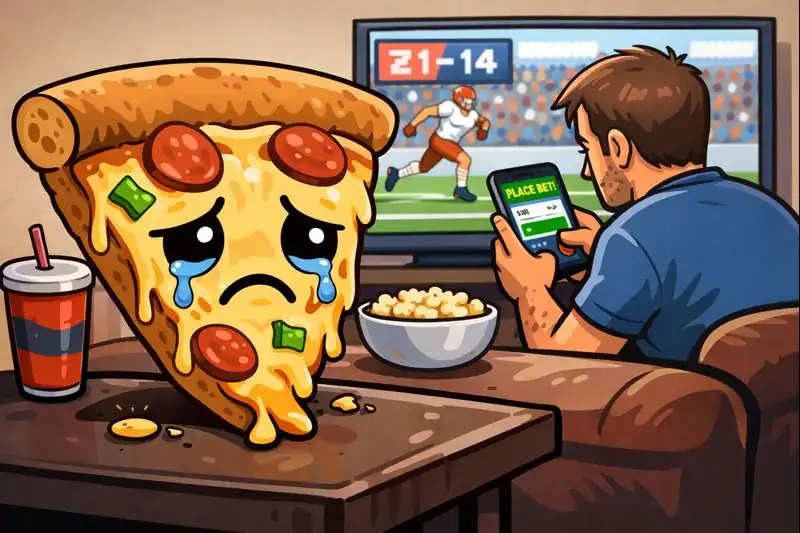
Has the expansion of legal sports betting since 2018 played a role in the declining interest in pizza in the United States?
The Wall Street Journal published an interesting article on Jan. 4 about the significant declines in sales of fresh/hot pizzas. People in the United States are “falling out of love with pizza,” the article claimed. Data showed that since 2018, thousands of pizza chain franchises have closed, and the situation for dine-in pizza restaurants has been similarly bleak.
From the report: “Once the second-most common U.S. restaurant type, pizzerias are now outnumbered by coffee shops and Mexican food eateries, according to industry data. Sales growth at pizza restaurants has lagged behind the broader fast-food market.”
The WSJ report didn’t mention sports or betting. This article will explore a possible connection.
What’s the Deal With Pizza?
There are, of course, all sorts of theories to explain why pizza sales are stale.
- The rise of DoorDash and Uber Eats has expanded consumer food delivery options.
- Perhaps inflation has affected pizza worse than some other food items.
- Maybe the U.S. protein craze hasn’t been good for a carb-rich food like pizza.
- Some people on social media speculated that weight-loss drugs have been bad news for the pies.
Many things could be true here, but correlation doesn’t mean causation.
Conor Sen, a Bloomberg columnist, offered another interesting theory. “I guess pizza’s a social food now that I think about it, so [it] mirrors the broader decline in socialization,” he wrote.
As part of what a former U.S. Surgeon General called a “loneliness epidemic,” Americans are hanging out with friends less than in previous generations. One reason for this appears to be habit-forming (i.e., addictive) smartphone apps of various kinds. Excessive internet use is often blamed, expressed in phrases such as “terminally online.”
People order a pizza for all sorts of social or work-related gatherings, but one classic example is for watching a sports game with friends and/or family. Going to a sports bar to get pizza and watch a game is also a pastime for some sports fans. Pizza sales would probably suffer if these social interactions were happening less often.
Pizza can be enjoyed alone, but according to Talker Research, Americans see pizza as the most “shareable” food.
The Rise of Betting Apps
It’s a coincidence that the WSJ pizza industry data begins in 2018, the year sports betting started to proliferate following a U.S. Supreme Court ruling. Since the May 2018 ruling, roughly 30 states have sanctioned sports betting apps.
Americans lost $13.7 billion on state-sanctioned sports gambling in 2024. Figures for 2025 are not yet available, but the industry’s revenue grew significantly year over year. Overall, household finances have taken a hit due to legal betting.
Online sports betting through offshore sportsbooks existed for many years before 2018. Still, the state sanctioning of apps such as DraftKings and FanDuel gave fledgling U.S.-based betting companies the green light to flood the airwaves with unprecedented levels of gambling advertising.
It appears the expansion of legal online sports betting has coincided with changes in how Americans watch live sports. A significant majority of American sports fans prefer to consume sports alone and at home.
- According to a 2024 Morning Consult survey commissioned by IBM, 70% of American sports fans said their “most likely place” for watching live sports is at home alone.
- 60% of U.S. sports fans watch game “summaries” daily or weekly, suggesting that a growing number of people are not watching full games, especially when alone.
- 74% of U.S. sports fans said the “most likely place” they watch game summaries is at home alone.
- There is evidence that gambling on a sports event increases a person’s interest in watching the game, but that doesn’t necessarily mean the whole game, especially if the bettor makes bets on several different games.
In 2025, more people were likely betting on sports via an app than ever before in the U.S. (10% of U.S. adults, according to Pew). That probably means more sports-related content was consumed than ever. However, the increase in sports content consumption appears not to translate to more time with friends/family watching sports.
Academic research has found that sports bettors tend to gamble alone.
Online sports betting is highly addictive, with more than half of online bettors reporting chasing losses, one of the classic signs of a gambling problem.
Cooking the Betting and Pizza Data
Has the explosion of legal sports betting taken a bite out of the pizza industry? It seems plausible, but it’s hard to distinguish between a nibble and something significant.
The argument here for a significant impact is that betting apps lead to more solitary sports consumption, resulting in fewer social occasions with pizza. To boot, sports betting can drain a sports fan’s discretionary spending budget.
In summary:
- More and more Americans are betting on sports through an app.
- Sports betting is addictive and hurts household finances.
- People who bet on sports, especially those with a problem, often do so alone.
- Most Americans prefer watching sports alone at home.
- Pizza is typically a social food and popular for sports gatherings.
There are also broader forces at play, including profound social isolation and health-related cultural shifts.
As the WSJ put it, “the outlook ahead isn’t much brighter” for pizza.
Discover more from GamblingHarm.org
Subscribe to get the latest posts sent to your email.