The City of Detroit has called prediction markets “bloodthirsty leeches” in a scathing court filing on April 2, 2026.
Detroit and the State of Michigan are in a heated legal battle with several prediction markets. Detroit claims in court documents that these federally certified platforms pose a serious threat to the city’s fiscal health.
“Detroit’s current stable economy will be derailed if Coinbase is allowed to continue operating as an unlicensed internet sports betting operator in Michigan,” the city said in an amicus brief.
What’s at Stake
The city receives nearly $160 million annually from state-sanctioned online gambling. It warned that the ability to fund public services would be “significantly reduced” if prediction markets aren’t stopped.
Detroit said that prediction markets are already hurting its finances.
“Plaintiff Coinbase and the other prediction market players that are currently infiltrating Michigan will not pay anything to anyone except their shareholders and clearly intend to eagerly and aggressively suck the business out of state-licensed online sportsbooks like bloodthirsty leeches,” lawyers said.
The legal fight over prediction markets comes as Gov. Gretchen Whitmer considers a tax increase for state-licensed platforms. Whitmer wants to raise more than $190 million in additional revenue each year from online gambling.
Gambling Addiction
Detroit is clearly right that prediction markets threaten its tax revenue. Prediction markets are addictive products that cause widespread gambling-related harm. In some cases, the result can be suicide.
The city wrote that prediction markets “encourage compulsive gambling […] without the guardrails provided by Michigan’s gaming laws.”
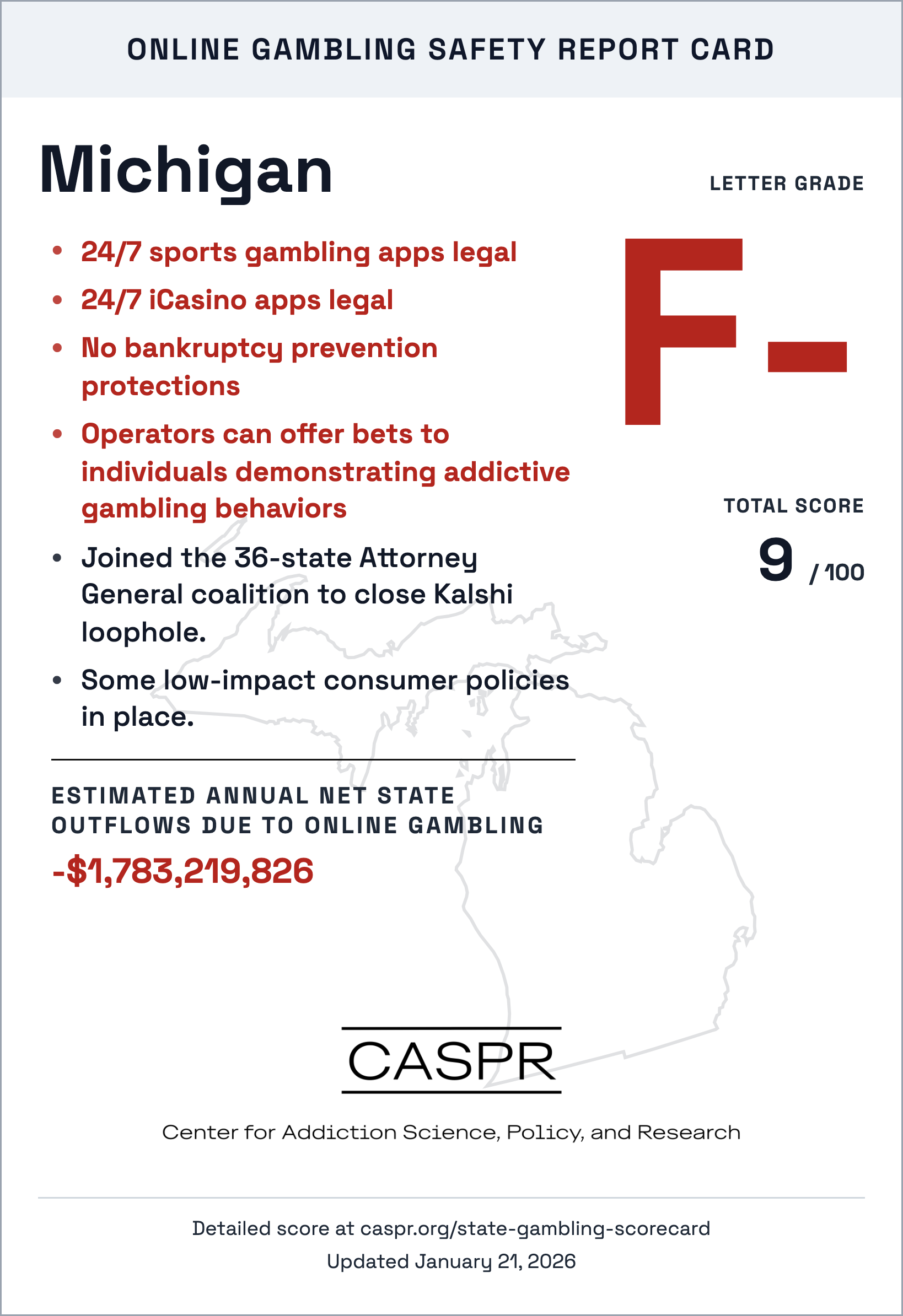
However, the city’s consumer protection argument is undermined by the fact that Michigan has authorized online casinos and sports betting, which also carry enormous addiction risks. According to The Center for Addiction Science, Policy, and Research (CASPR), Michigan’s oversight of these platforms is woefully inadequate.
CASPR gave Michigan a failing score for its regulation of the online gambling industry. Michigan’s safeguards, such as online gambling self-exclusion, may work for some individuals, but they are ineffective at the population level.
Surveys indicate that half of online sports bettors report chasing losses. Problem gambling typically affects six others per person experiencing addiction, suggesting that gambling harms may impact millions of Michiganders. The state continues to rely on the widely criticized “responsible gambling” approach.
Offshore gambling websites severely harmed many Michiganders long before the state legalized online casino/sports betting. Nevertheless, the legalization of the industry led to ubiquitous advertising of online gambling and the evolution of online betting to include more predatory features.
Bottom Line
Detroit is caught between a rock and a hard place.
A new form of federally regulated online sports gambling is siphoning off its tax revenue from online gambling. But it’s gaslighting for Detroit to say prediction markets are predators while Michigan’s licensed online gambling platforms currently benefit the public.
The reality is much more complicated, as experts say Michigan must do a better job regulating these addictive products.
Perhaps online gambling as a way to fund a city was always too good to be true.