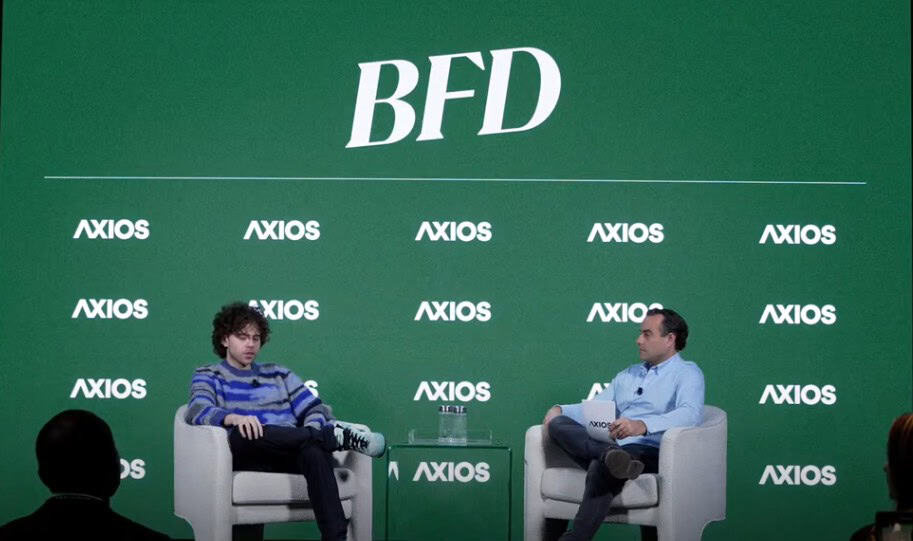
Polymarket CEO Shayne Coplan shared his cynical — albeit partially accurate — thoughts on legal online sports gambling in the United States.
Coplan’s Polymarket is an online “prediction” platform that facilitates yes-or-no-style gambling on sports, politics, current events, and more. So-called prediction markets claim federal oversight under the CFTC, which they argue lets them avoid state sports gambling regulators.
In a short interview at Axios’ BFD Summit in New York on Nov. 18, Coplan explained that he thinks traditional online sports gambling apps like DraftKings and FanDuel are a “scam” because they “profile” their users.
Nonetheless, he said he respects them, indicating his intentions to compete with them for the U.S. sports gambling market. Legal U.S. sportsbooks raked in $13.7 billion in 2024, even as several of the most populous states remain on the sidelines.
What Did Coplan Say?
Here’s his full quote:
“The way that it currently works is that there is a duopoly instituted for sports betting in America, upheld by a patchwork, state-based solution, where every single state is like some sort of weird backdoor lobbying — the tribes get this, the tax is this rate, everything is this hodgepodge solution, and as a result it is so goddamn complicated and expensive that no new entrants can enter the market… If you look at all four of those products (DraftKings, FanDuel, BetMGM, and Fanatics), they are all identical; none of them innovates, they all rip off the consumer, respectfully. Not that they’re not fun on gameday.
“But the important thing is, if you are participating in a market on the outcome of a sports game, that’s a financial market. That’s what it is. The idea that the way they should be regulated in America, America, capitalism, innovation, competition, is that the only way to do it legally is if you, when you use the app, you can only trade against the house. They can go and ban you if you make money. They can kick you off. They can profile you as a user and change the prices based on you. That’s a scam. In traditional finance, that’s like a bucket shop, that’s like a scam, those are illegal. You can’t expect to run a business that is that rigged against the consumer, in perpetuity, in America. America is the land of people competing and people innovating.”
Unpacking Coplan’s Comments
- He is correct that DraftKings and FanDuel function as a politically powerful duopoly with about 80% market share.
- He appeared to be on the right track in pointing out that lobbying around online sports gambling has been controversial, with policymakers across the country giving online gambling companies close to free rein to profit from gambling addiction. The lobbying has worked in the majority of states so far.
- It’s deeply cynical to call online sports gambling apps a scam but in the same breath say you respect their businesses. They do harm users, but so can Polymarket.
- He is misleading when stating that “trading” on the outcome of sports events is a “financial market.” This issue is still up in the air, and the courts will decide whether it’s true.
- He is right that some sports gambling app users are limited or “banned” if they consistently beat line movements or use other methods to try to gain an edge. That said, it’s a tiny percentage, as the vast majority of users lose and engage with sports gambling in the form of parlays or other wager types with high sportsbook hold percentages.
- He’s right that the status quo around online sports gambling is on shaky footing. A recent Pew Research Center survey found that a growing number of Americans (43% of adults in 2025) view legal sports gambling as a “bad thing for society.” Pressure is growing for a public health approach.
- His sentimentality toward free-market American capitalism rings hollow, given that the son of the sitting U.S. president backs his company. Critics have accused the CFTC regulatory regime of being a form of corruption.
What Polymarket’s Coplan Didn’t Say
He didn’t mention gambling addiction, which users of his platform are not immune to. There is no indication that sports gambling through a prediction market will be any less addictive than using a traditional gambling app.
In fact, prediction market gambling could be more addictive for some users because of a strategic component involved with buying and selling shares. The intermittent reinforcement in gambling games such as sports betting and poker can be more harmful to some people.
Online sports gambling in any form can be highly addictive.
To make matters even riskier, prediction markets allow registered users as young as 18.
He also danced around answering a question about why the prediction market version of online sports gambling should be available in states such as California, Texas, and Georgia, where policymakers have not legalized online sports gambling in any form.
To compete with Polymarket and Kalshi, another leading prediction market, FanDuel and DraftKings announced plans to launch their own versions of the product. Their decision led to relinquishing their memberships to the American Gaming Association.
Polymarket Gambling Help
The growing popularity of Polymarket will cause more people to be exposed to addiction.
You are not alone if you’ve developed an addiction to Polymarket. You should consider talking to a therapist or counselor for help quitting gambling.
A gambling prevention or recovery coach could also help you or someone you know. Studies have shown that half of online bettors experience problems with their play.
Discover more from GamblingHarm.org
Subscribe to get the latest posts sent to your email.