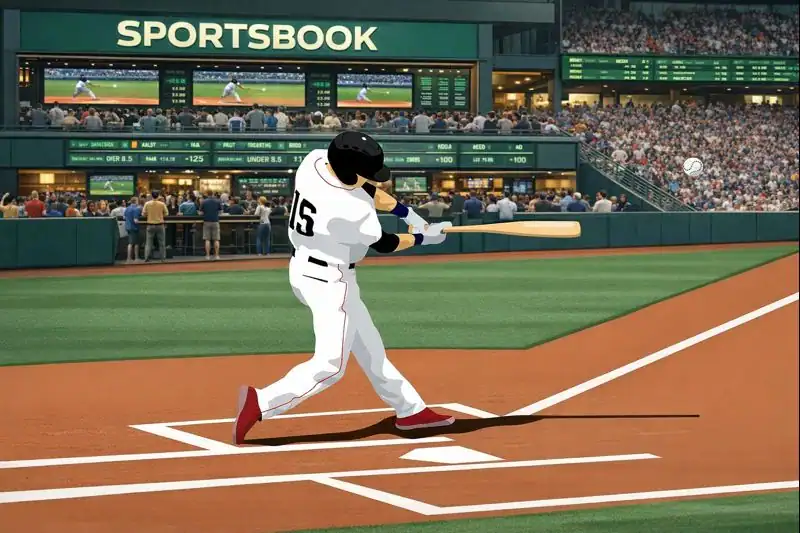
Prop bets, which include sports wagers on an individual player’s performance, are an engagement and revenue driver for online sportsbooks.
In 2025, a player prop user:
- Placed 3.6x as many bets
- Generated 3.2x as much gross gaming revenue
- Wagered on 2.9x as many games
Source: Kambi Group, a leading B2B supplier of odds and risk management to sportsbooks in the U.S., Europe, and Latin America. Figures are compared to non-prop NBA bettors and may vary by sport.
Sportsbook websites and apps of various kinds rely heavily on props. This article will examine the risks, harms, and regulatory challenges associated with player prop bets.
What Is a Prop Bet?
Let’s quickly flesh out what a prop bet is. As mentioned, they are typically player-specific wagers.
A player prop bet can be for the entire game, such as whether a baseball player will hit a home run. They can also be “microbets,” such as whether a player will get a hit in a single at-bat.
Wagers on the number of home runs a player will hit over the course of a season, for example, are not usually called props. These bets are called player “futures” (a term to describe bets that go beyond a single game or contest).
All sports can have prop bets, though prop bet options for a particular sport vary based on the sportsbook. For example, a sportsbook might only offer a moneyline (straight bets on who will win) on a niche game like chess.
The NFL Super Bowl has the most prop bets for any single sporting event. For the Super Bowl, prop bets also include the result of the coin toss and the color of the Gatorade.
Prop Bets in Parlays
Player prop bets are a ubiquitous component of parlays, including same-game and multi-game parlays. Parlays are the primary revenue driver of sportsbooks.
In New Jersey, one of the largest sports betting markets in the U.S., parlays account for around 60% of online sports betting revenue. Only a handful of states release information on parlay revenue.
Props turn one game into dozens of potential parlay legs, which increases volume and hold.
Without prop bets, sportsbooks would see users make fewer parlays.
Are Prop Bets More Addictive Than Other Bets?
Prop bets can be more addictive when made as in-game wagers (i.e., live bets while the game or contest is ongoing).
Live betting can be rapid, making sports betting close to a slot machine. The continuous betting mechanics of in-game props can be more addictive for some users.
It’s the speed of gambling, more than player-based betting, that poses the potential for greater harm.
That said, props of any kind (e.g., pre-game props) could give some bettors a stronger illusion of control. Gambling-related myths and fallacies have proliferated in recent years.
In the U.S., roughly half of online bettors report chasing their losses.
Why Player Prop Bets are Risky for Leagues
Arguably, the most straightforward element of a sports contest to corrupt is a single participant’s performance. It can be a crime involving just one person.
A player can do something for gambling-related reasons without necessarily impacting the outcome of the game. Corruption of in-game details in this manner is called spot-fixing, which is distinct from match-fixing.
Spot-fixing can be challenging to detect. Typically, sportsbooks can detect suspicious wagering activity and then alert the sports league.
Over/Under Props
For some props, sportsbooks take wagers on whether a participant will have more or fewer of something (i.e., “over” or “under” for a statistical category).
So-called “under props” — wagers on a player to perform beneath or worse than a number related to their performance — are particularly vulnerable to corruption.
In October 2025, a federal indictment alleged misconduct related to bets on whether NBA players would score fewer points than their pre-game betting line.
NCAA Opposition to Prop Bets
Among the sports leagues, the NCAA is the most opposed to player props. It has lobbied states to ban prop bets on all college sports, but it has also partnered with a sports betting data distributor in an attempt to gain greater control over props.
The reason is twofold: Student-athletes interact closely with fans (and bettors) on campus and may have a greater financial incentive to corrupt a game.
Roughly 20% of sports bettors report anger issues rising to the level of athlete harassment. Student-athletes are especially vulnerable to abuse.
College prop bets are prohibited in some states with legalized sports betting. However, more than half of the 39 states with legalized sports betting and Washington, D.C., allow individual college prop bets in some capacity.
“The NCAA national office regularly hears concerns from schools and student-athletes across the country on the impacts of sports betting,” NCAA President Charlie Baker said in a statement in January 2026 following a point-shaving scandal. “Those schools and student-athletes cite issues surrounding player prop bets, including instances of harassment, competition integrity and other well-being concerns.”
Ohio Gov. Mike DeWine has been one of the most vocal supporters of the NCAA’s position.
Why Props Aren’t Going Anywhere For Now
It’s an uphill battle for opponents and critics of prop bets.
In addition to traditional state-sanctioned sportsbooks, props are available via several other forms of sportsbook gambling, including prediction markets, DFS platforms, offshore betting sites, and sweepstakes sportsbooks.
Prediction Markets
So-called prediction markets have found a way around state regulation of sports betting. The Commodity Futures Trading Commission (CFTC) controversially certifies these gambling apps.
They offer a stock-market-style form of sports betting, including props.
The NFL and NCAA have formally expressed concern about prediction markets, as these platforms may be more vulnerable to insider gambling.
Critics argue that the CFTC has been derelict in its duty to enforce the law prohibiting so-called “sports event contracts.”
Prediction markets include Kalshi, Polymarket, Robinhood, DraftKings Predictions, and FanDuel Predicts.
Daily Fantasy Sports (DFS) 2.0
DFS 2.0 is industry shorthand for the newer wave of “daily fantasy” products that look and feel like sports betting player props, usually in a pick’em format.
Instead of building a full fantasy lineup under a salary cap (classic DFS), users pick “more/less” (over/under) outcomes on individual player stats (points, rebounds, yards, etc.) and often stack multiple picks together for a bigger payout — basically a prop parlay in fantasy clothing.
Controversial DFS 2.0 platforms include PrizePicks, Betr, and Fliff.
Offshore Gambling Sites
Sports betting websites and apps based outside the U.S. sometimes facilitate gambling for people inside the U.S. These platforms are allegedly illegal under state and federal law.
Nonetheless, many offshore sportsbooks flout the law. They offer prop bets, and states such as Michigan and Tennessee have taken a whack-a-mole strategy to force some of them to cease operations.
Offshore sportsbooks include BetOnline, BetWhale, and Bovada.
Sweepstakes Sportsbooks
So-called sweepstakes gambling platforms use a highly controversial dual-currency model to allegedly circumvent state gambling regulation. They essentially use sweepstakes laws that apply to a game like McDonald’s Monopoly to offer casino and sports gambling.
Numerous states have criminalized sweepstakes casinos and sportsbooks.
Sweepstakes platforms include MyPrize, Sportzino, Fliff, and Dogg House Casino.
Bottom Line: Prop Bets a Core Feature of Sports Betting
Prop bets are often the most controversial element of online sports betting because of the risks they pose to game integrity and the potential harm from in-game betting.
Player props appear to be a core reason for the deterioration in public opinion of legal betting.
For sportsbooks of various kinds, prop bets drive the action. Sports betting operators will resist any attempt to prohibit props.
The existence of unregulated and quasi-regulated sportsbooks complicates legislative efforts to ban or restrict props.
Discover more from GamblingHarm.org
Subscribe to get the latest posts sent to your email.