
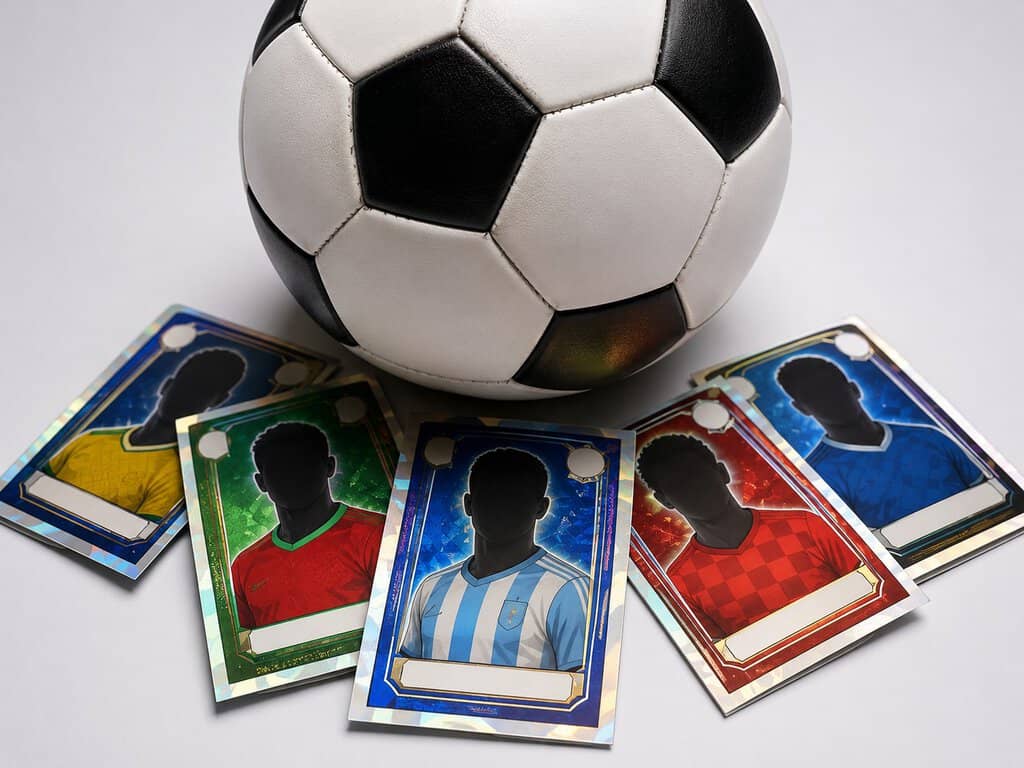
This question recently came up with my own family. One of my children was riding his bike around town hunting for World Cup Panini cards. Then my younger son casually mentioned that he had already spent $150 on packs this summer.
The discussion went like this.
Me: Did you know that our son spent $150 on Panini packs?
Dad: Yes, he spent $150 on stickers for his World Cup book, which he earned by mowing lawns. (Pause.) They are not cheap, but he does one every World Cup.
(My thought: “So he did one when he was aged 3, 7 and 11?”)
Me: Does he try to collect all 980 and obsess about them?
Dad: No, it’s a healthy balance.
At first, the answer to this article title seems obvious: Collecting cards is not gambling.
Many of us grew up buying baseball cards, Pokémon cards, Magic: The Gathering cards (if you were a nerd like me), football cards, and so on. There is nostalgia in it. McDonald’s Monopoly was a similar “collecting” game.
How Kids Use WC Panini Cards
World Cup Panini cards are officially licensed collectibles released by Panini every four years for the FIFA World Cup.
Kids trade duplicates at school, compare favorite players, build albums, and can enjoy the basic delight of collecting. But the question becomes more complicated when we look beyond the hobby itself and ask what the child is actually experiencing.
When I speak to kids, I usually teach the definition of gambling in a simple way: you put something of value at risk—money, time, attention, or emotion—in the hope of getting something more valuable back, and the outcome is uncertain.
A pack of cards is a mystery. A child pays for a pack, opens it, and waits to see whether something rare, exciting, or valuable appears. Sometimes there is disappointment. Sometimes there is a surprise.
And every so often, there is a “big hit” that makes the child want to try again. This may not be gambling in the traditional sense. But psychologically—especially for a child or adolescent—it is worth asking what is really being learned.
The Power of Uncertainty
Psychology 101 teaches us that intermittent and unpredictable rewards are especially effective at reinforcing repeated behavior. We use this with things like dog training, teaching social skills, rewarding employees, and in marketing.
This is the same basic psychological principle behind many gambling products: variable reward. The reward does not come every time, nor does it come predictably. That unpredictability is precisely what makes the experience exciting.
Spend. Anticipate. Reveal. React. Repeat.
That is the concerning part—not the World Cup Panini cards themselves, but what the chase can start to teach a child:
- Paying for uncertainty is exciting.
- Rare outcomes are worth chasing.
- Disappointment can be fixed by trying again.
- Spending more increases the chance of eventually getting the desired reward.
- A “near miss” feels like motivation rather than loss.
The Loot Box Comparison
Loot boxes take the same basic structure of blind card packs and digitize it.
A player pays, opens a box, and receives a randomized reward. Researchers have described loot boxes as virtual items with features reminiscent of gambling, and studies have found associations between loot box use and problem gambling in youth.
The difference, however, is frequency and intensity.
A child buying Panini cards has some natural limits. The child needs money, access to a store, and time. Packs are physical. The process has friction.
Loot boxes remove much of that friction. They can be purchased instantly. They are often embedded directly in games children already play. Payment may be saved on a device and does not feel the same as handing over a hard-earned crisp $20 bill. The reward animation is designed to heighten excitement. The next opportunity to buy appears immediately.
When Should Parents Pay Attention?
The line is not crossed when a child buys a pack of World Cup Panini cards.
The concern rises when the behavior becomes less about collecting and more about chasing.
Parents should pay attention when:
- A child becomes preoccupied with buying more packs.
- Disappointment after opening packs leads to repeated requests to buy more.
- The child focuses mostly on value, rarity, or resale rather than enjoyment.
- The child becomes secretive about spending.
- The child feels unable to stop until a certain card is obtained.
- Trading or collecting becomes a source of distress, conflict, or shame.
- The child begins describing packs in gambling-like terms: “I’m due,” “just one more,” “I almost got it,” or “next time I’ll hit.”
Those phrases matter because they reveal how the child is interpreting chance.
The issue is not whether a child enjoys collecting. The issue is whether the child is beginning to relate to the activity through compulsion, loss-chasing, or distorted expectations about probability.
Parents Can Avoid Overreacting
Parents do not need to prohibit all card collecting in response to World Cup Panini cards. In fact, converting every chance-based hobby into a forbidden object may be unhelpful and unrealistic.
A better approach is to help kids see the design behind the excitement, so it sounds familiar to them in the future, before they decide to move from card collecting to loot boxes to online gambling platforms.
Parents can say:
- “It is fun to open one, but buying more does not guarantee you’ll get what you want.”
- “Let’s decide the spending limit before opening packs.”
- “If you feel upset and want to buy more right away, that is a good time to pause. Let’s wait a day before buying more and see if you still want them tomorrow.”
- “The rare card is designed to make you want another pack.”
- “The company makes money because most packs do not have the rare cards.”
- “If the fun depends only on getting a rare card, then it may not be fun anymore.”
- “Before we spend more, let’s ask whether we are collecting or chasing.”
- “A near miss can feel like you are getting closer, but it does not actually change the odds of the next pack.” (i.e., the gambling fallacy)
- “You are allowed to be disappointed, but we can’t fix it by spending right away.”
These conversations teach children something essential: how to recognize when excitement is deliberately being created. That skill matters far beyond trading cards. It applies to gaming, social media, sports betting, shopping apps, and countless other digital products designed to convert attention into spending.
Bottom Line
Card collecting, such as World Cup Panini cards, is not the same as gambling.
But when the excitement comes less from collecting and more from chasing a rare outcome, the psychology begins to overlap with that of “just a hobby” and gambling.
The task for parents is not to panic. It is to notice, set limits, and help children understand the system they are participating in.
Because the earlier children learn to recognize the mechanics of chance-based reward, the better prepared they will be when those same mechanics appear in digital games, sports betting, and so on.
Cards and games are not dangerous on their own. The chase—promoted by clever marketing and an understanding of psychology 101—is what we should teach children to recognize before unregulated or poorly regulated industries teach them to keep paying for it.
“The Doctor Against The House”
Written from the exam room and the kitchen table, this column examines modern gambling as a preventable public-health harm, not a personal failure—and demands accountability where it belongs.
Kavita Fischer, MD, is a board-certified child, adolescent, and adult psychiatrist based in Pittsburgh, Penn. She is the president of the Pennsylvania Psychiatric Society and a national advocate on gambling-related harm. Drawing on both clinical practice and lived experience with gambling addiction, Dr. Fischer examines modern gambling as a preventable public-health threat—and to challenge the systems that profit while families absorb the damage.