
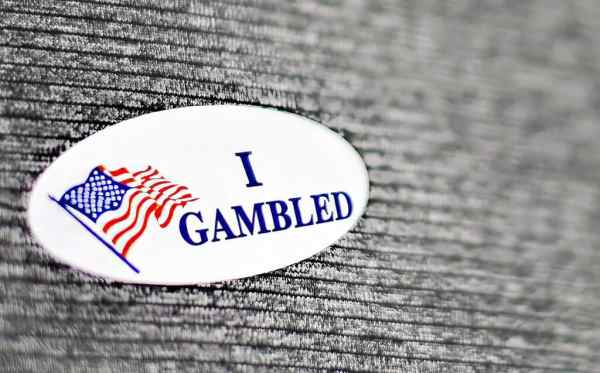
Betting on political events, including elections, is legal in the U.S. via prediction markets. Doing so carries financial and addiction risks.
Under Commodity Futures Trading Commission regulation, platforms like Kalshi, Polymarket, DraftKings, and FanDuel offer contracts on elections. Media companies such as CNN and FOX promote election gambling odds.
These betting platforms bypass state-level law. No state has enacted a law to allow election betting.
Meanwhile, unregulated offshore sites offer political gambling in violation of state and federal law. Some states have acted against these sites through cease-and-desist letters.
How Election Betting Works
Prediction markets allow gamblers to risk money by trading “shares” in a method akin to stock market trading.
Users can buy or sell their shares in an election outcome up until the election result is finalized.
Prediction markets take bets on the presidential and midterm elections. They also allow betting on state-level races, such as the governor. They also take bets on political debates through so-called mention markets.
Insider Trading Playground?
Election prediction markets could have insiders with privileged data outmaneuver the public for profit. This creates a significant imbalance in market dynamics.
For example, an NPR report found campaign staffers used private polling to profit from markets like Kalshi and Polymarket. The report details cases in which staffers placed bets just before polling results were released, thereby profiting from market shifts.
One staffer even mentioned that knowing upcoming polling allowed individuals to make a “quick $5,000.”
Private Polls Give Insiders Advantage
Because of these risks, campaigns handle internal polling carefully in their reporting to avoid leaking favorable numbers. However, in prediction markets, even timing a leak can produce a payday.
Complicating matters further, a campaign aide need not know whether a poll is accurate—just that it’s about to move the market, underscoring how sensitive timing can outweigh the quality of the information.
A former CFTC trial lawyer told NPR that this kind of trading could justify an investigation, but enforcement can be challenging given resource constraints and a lack of specialized tools.
Former CFTC Commissioner Kristin Johnson said the agency has not developed deep expertise in policing election positions, highlighting current enforcement limitations.
Enforcement Actions
Concerns over insider trading are not just theoretical. Kalshi has reported taking enforcement action against political candidates who bet on their own races.
Specifically, in April, Kalshi stated that three cases involved what the company called “political insider trading”—instances that were flagged by automated safeguards designed to prevent candidates from profiting from elections in which they participate.
However, Kalshi’s own enforcement mechanisms have limits, as they rely on automated detection and self-reporting rather than formal regulatory oversight.
Reuters reported that Kalshi suspended three congressional candidates from Minnesota, Texas, and Virginia for betting on their own races.
How Elections Betting Became Legal
Just days before the 2024 presidential election, Kalshi won a court case and subsequently increased its presence on various social media channels with advertisements about election gambling.
Following the Kalshi ruling, the stock-trading platform Robinhood began facilitating election trades.
Polymarket, the most prominent crypto-gambling site taking U.S. election bets, was forced out of the U.S. market in a 2022 settlement with the CFTC. Gambling platforms banned in the U.S. could still be accessed through virtual private networks (VPNs).
Right now, 32 states regulate online sports betting, but none permit political wagers. Ontario, Canada, allows its licensed sportsbooks, such as FanDuel and DraftKings, to take U.S. election bets.
States such as New York, Minnesota, and Iowa have considered policies to regulate platforms that take election bets.
Lawmakers Seek to Ban Election Odds
Election gambling is highly controversial among state and federal lawmakers.
In late 2024, representatives Jamie Raskin (D-MD) and Andrea Salinas (D-OR) introduced the Ban Gambling on Elections Act to prohibit betting on U.S. elections. The bill is the House companion to Senator Jeff Merkley’s (D-OR) legislation.
The proposal would amend the Commodity Exchange Act—a law that regulates the trading of commodities and futures in the U.S.—to prohibit any political election wagering.
“With distrust in our electoral system at an all-time high, we must crack down on gambling in all U.S. elections,” Raskin said. “Our democracy demands reliable and transparent processes to cast ballots and tally results, not a horse race clouded by gambling odds and bets placed.”
More Risks With Politics Gambling
Rep. Salinas stated he would also seek to provide more federal resources for problem gambling treatment and research.
“While sports betting and online gambling have become permanent forms of American entertainment, we must acknowledge and help mitigate the harm caused by related addictions,” he said.
Sen. Merkley said that election gambling can incentivize “funding late-cycle smear campaigns” that erode trust in democracy.
“It’s like betting on a baseball game when you control the umpire,” Merkley added.
According to Dennis Kelleher, president of the think tank Better Markets, the CFTC is poorly equipped to regulate election gambling, including establishing safeguards to protect problem gamblers.
“Gamblers also should not be allowed to unleash gambling on American elections by sneaking it in through the back door of the CFTC, which has no expertise, experience, or ability to regulate or police election gambling,” Kelleher said.
Addiction Harm with Election Bets
GamblingHarm.org is unaware of research into how addictive election betting is relative to wagering on March Madness or the NFL.
According to betting addiction statistics, approximately 50% of online bettors experience problems related to wagering. Betting on real-life events could also be highly addictive.
Election betting may be highly addictive because elections are emotional events. This emotional aspect is one reason NFL gambling appears to have a high addiction rate among sports.
Political news coverage is saturated with so-called insider scoops, giving observers (and potentially election gamblers) the unfounded feeling that they can better predict these outcomes than the result of a sports contest.
Image from Thor Deichmann from Pixabay