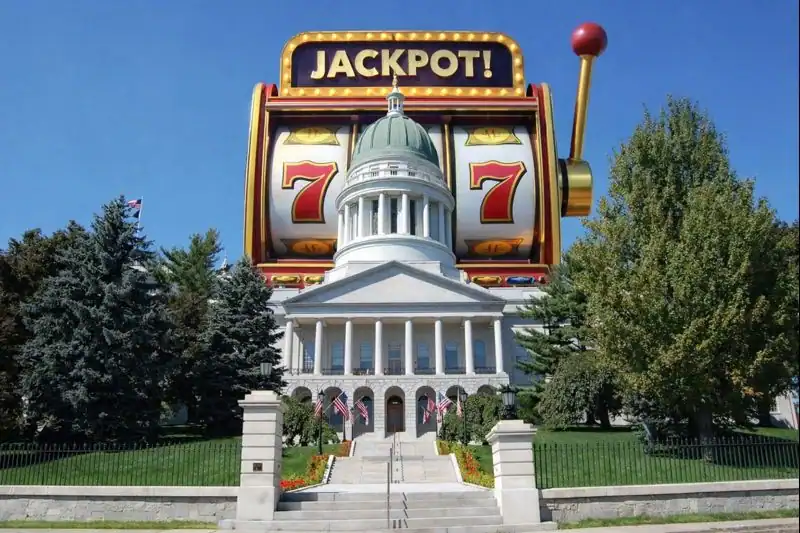
Some online casinos will be legal to operate in Maine under a highly controversial law that the governor announced she would allow to go into effect.
Legal online casinos in the state are expected to launch later in 2026, pending regulatory approval. Maine will tax online casinos at one of the nation’s lowest rates.
The legislation, LD 1164, authorizes the Wabanaki Nations in Maine to operate online gambling “to support economic development and investments in tribal communities.”
There will be some winners, but an enormous number of losers.
DraftKings, Caesars to Also Reap Rewards
Proponents of online casinos consider the law “historic” because it gives control over lucrative online casinos to Maine’s four federally recognized tribes and not commercial interests. In 2022, Maine gave the tribes the exclusive right to operate online sports gambling.
Tribes in Maine do not have brick-and-mortar casinos.
The tribes don’t own the technology to operate online gambling apps. By law, Maine’s tribes can partner with sports betting app developers. In Maine, DraftKings Sportsbook and Caesars Sportsbook siphon money from residents through their respective mobile betting products.
DraftKings and Caesars will likely offer casino gambling in Maine alongside sports betting. Other betting app brands could compete for one of four available licenses to offer online casino gambling.
Maine Gambling Addiction to Rise
Online gambling is highly addictive and hurts the population of a state. Mills acknowledged online gambling would cause addiction, but she supported the law anyway.
“I considered this bill carefully, and while I have concerns about the impacts of gambling on public health, I believe that this new form of gambling should be regulated, and I am confident that Maine’s Gambling Control Unit will develop responsible rules and standards to hold providers of this new form of gambling accountable while ensuring that Maine’s tribes benefit from its operations.”
So-called “responsible” gambling safeguards, such as self-imposed deposit and time limits on a gambling platform, are ineffective at preventing harm at the population level.
Just two percent of the online casino gambling revenue generated in Maine will go to the state’s Gambling Addiction Prevention and Treatment Fund.
The Maine Gambling Control Board opposed the legislation, saying it was ill-conceived and would increase addiction in the state. The Gambling Control Unit, which is part of the state’s Department of Public Safety, will oversee online casinos. The Board will not be the regulator.
“Removing casino games from the regulatory authority of the Gambling Control Board violates Maine law and renders the Board effectively useless,” the agency wrote in a December letter.
‘iGaming’ Euphemism Used by Maine Tribes
Mills’ January 2026 statement used the word “gambling,” but the tribes used “iGaming,” short for “internet gaming.”
Notably, the governor neglected to use the legislation’s “internet gaming” language. She took months to announce she would make it law after it passed the legislature in mid-2025.
Tribes in Maine praised the legislation and peddled the falsehood that state-sanctioned online casinos are about protecting consumers. Research has shown that legalized online gambling increases population-level harm.
“For too long black-market websites have hosted illegal iGaming, with no protection for our youth and vulnerable adults,” claimed Maliseet Tribal Chief Clarissa Sabattis. “LD 1164 will create a closely regulated iGaming market with strict controls and will ensure much needed revenues remain in Maine.”
Polling has shown that most people don’t know that iGaming means online casino gambling.
The tribes believe online casino revenue will be “life-changing.”
Repeal Efforts Underway?
A commercial casino industry group that opposed the Maine online casino legislation announced that it will lead a repeal effort. The repeal campaign has uncertain chances.
Churchill Downs and PENN, Maine’s commercial casino operators, opposed the bill. “Cutting out Oxford and Hollywood Casinos entirely from offering iGaming is ill-advised and creates a monopoly that is harmful to consumers and the Maine workers employed by Oxford and Hollywood Casinos,” the Gaming Control Board wrote in their defense.
The National Association Against iGaming, which is backed by brick-and-mortar casinos, speculated that Mills was motivated by her upcoming U.S. Senate primary. If elected, she would be among the oldest first-term senators in history.
She is running to defeat Graham Platner, who has been more progressive than Mills on tribal issues, according to the Bangor Daily News. That could explain Mills’ support of tribal-run online casinos.
“While only [Mills] can explain her change of heart, it is difficult to view this decision as anything other than a political calculation rather than a policy driven by evidence or public interest,” Leo Rommel, a spokesperson for the National Association Against iGaming, said in a statement.
Mills’ announcement on the online casino bill reads like a political advertisement on her efforts to support tribal communities. She listed 16 other policy efforts to support tribes.
Maine Online Casinos FAQ
Which tribes in Maine can conduct online gambling?
Penobscot, Passamaquoddy, Mi’kmaq, and Maliseet, which are all part of the Wabanaki Nations. Under state law, the tribes can operate online sports betting and online casino gambling.
Why did Maine legalize online casinos?
There were several forces at play behind Maine’s legalization of online casinos.
Tribal gambling interests in Maine want to offer online casino games to generate more revenue and use it for various services and infrastructure improvements. They also claim that unregulated gambling sites, such as predatory sweepstakes casinos and offshore platforms, are taking money away from Maine’s legal gambling market. There is some truth to this argument, but government-sanctioned gambling leads to even more harm.
Maine’s government said it wanted to bolster economic support for tribes, which have been socially disadvantaged. In Maine, supporting tribal sovereignty is a popular political issue, as it should be.
The state of Maine will also benefit financially by taking its share of the money that tribes generate from online casino gambling. According to a state fiscal note, Maine will get an 18% cut of the revenue online casinos will generate in the state. It anticipated $1.8 million for FY25-26 and $3.6 million for FY26-27.
How many states allow online casinos?
Maine is expected to become the eighth state to sanction online casino gambling. The other states are Connecticut, Delaware, Michigan, New Jersey, Pennsylvania, Rhode Island, and West Virginia. Nevada allows online poker.
Mississippi and Virginia saw the introduction of online casino bills in 2026.
What gambling apps are legal in Maine?
The legal online sports gambling apps in Maine are DraftKings and Caesars. BetMGM, Fanatics, FanDuel, and Bet365, for example, are not allowed in Maine.
Offshore gambling platforms like BetWhale are also illegal in Maine.
Whether the gambling site is legal or illegal, it can cause widespread financial harm to state residents and visitors.
Is DFS legal in Maine?
Fantasy-style sports betting is also allowed in Maine. DraftKings, FanDuel, RealTime Fantasy Sports, PrizePicks, and OwnersBox are Maine-approved fantasy contest operators.
Daily fantasy sports (DFS) can also cause addiction and financial harm.
Discover more from GamblingHarm.org
Subscribe to get the latest posts sent to your email.