
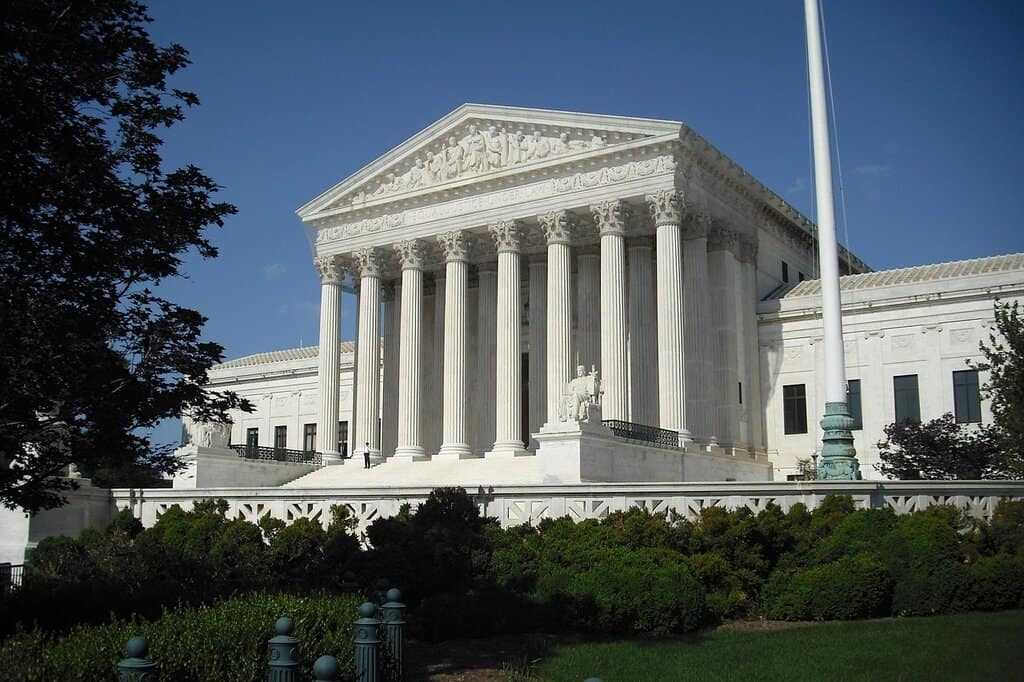
A coalition of leading advocacy groups is asking the U.S. Supreme Court to reconsider a key part of its landmark 2018 Murphy v. NCAA decision.
If successful, it could reopen the door to a federal prohibition on commercial sports betting authorized by states. Doing so could potentially save millions of Americans from financial harm linked to online sports gambling.
Stop Predatory Gambling, the Association of American Physicians and Surgeons, and Texans Against Gambling filed a 37-page amicus brief Wednesday in Flaherty v. Kalshi. That case involves whether prediction market operator Kalshi may offer so-called “sports-event contracts” outside the bounds of state sports gambling laws.
New Jersey-based attorney Andrew L. Schlafly, counsel for the amici, submitted the brief on the groups’ behalf.
Brief Background
On May 14, 2018, the Supreme Court controversially sided with New Jersey in Murphy v. NCAA, ruling 7–2 that the Professional and Amateur Sports Protection Act of 1992 (PASPA) prohibition on states authorizing sports betting violated the Constitution’s anti-commandeering principle.
A 6–3 majority then concluded that the Court could not sever the unconstitutional provision from the rest of PASPA, effectively striking down the federal sports betting law in full.
That distinction is now at the center of the new Supreme Court filing.
Roughly eight years after the ruling, former U.S. Surgeon General Jerome Adams has described the legal sports betting boom as the “new opioid crisis.” Recent polling shows more Americans oppose legal sports betting than support it.
Even former New Jersey Gov. Chris Christie, who led the effort to overturn PASPA, has expressed concern about the industry’s growth. Christie recently said he never anticipated sports betting being “in everybody’s pocket” and called its proliferation “a little bit disturbing.”
Groups Seek to Revive Part of PASPA
The groups want the Supreme Court to add a major question to the case: whether Murphy wrongly struck down Section 3702(2) of PASPA.
That provision made it unlawful for a private party to operate, advertise, or promote sports wagering “pursuant to the law or compact of a governmental entity.”
The brief argues that unlike another portion of PASPA, Section 3702(2) directly regulated private conduct and was not itself challenged by the parties in Murphy.
The Supreme Court nevertheless invalidated the provision after finding it could not be severed from the unconstitutional portions of PASPA.
The amici argue that decision was flawed and that Congress never repealed Section 3702(2). They contend the provision could therefore still operate as a federal ban on commercialized sports betting if the Court reverses its severability analysis.
Murphy Under New Scrutiny
The brief points to Justice Clarence Thomas’ concurrence in Murphy, which questioned whether courts should strike down statutory provisions that no party has standing to challenge.
It also argues subsequent Supreme Court decisions have embraced a stronger presumption that valid portions of laws should remain intact.
If the Supreme Court accepted that argument, the consequences could extend far beyond Kalshi. The filing argues a revived Section 3702(2) could once again prohibit state-authorized commercial sports betting — effectively undoing one of the most consequential effects of Murphy.
‘An Axe’ to PASPA
Justice Samuel Alito wrote for the majority that PASPA’s prohibition on states authorizing sports betting violated the Constitution’s anti-commandeering principle.
Alito reasoned that the problem with the law was that Congress did not make sports betting a federal crime. Instead, it prohibited states from authorizing legalized gambling, improperly infringing on their authority.
Chief Justice John Roberts and Justices Thomas, Anthony Kennedy, Elena Kagan, and Neil Gorsuch joined Alito’s opinion.
The late Justice Ruth Bader Ginsburg wrote that even if the part of the law regulating states’ behavior should be struck down, the rest should have survived. Ginsburg, joined by Justice Sonia Sotomayor and, in relevant part, by Justice Stephen Breyer, argued that the private-party prohibition should survive and said that when a portion of a law is unconstitutional, the court typically “engages in a salvage rather than a demolition.”
She said that instead of using a “scalpel to trim the statute,” the majority used “an axe.”
Image by William Murphy from Pixabay