
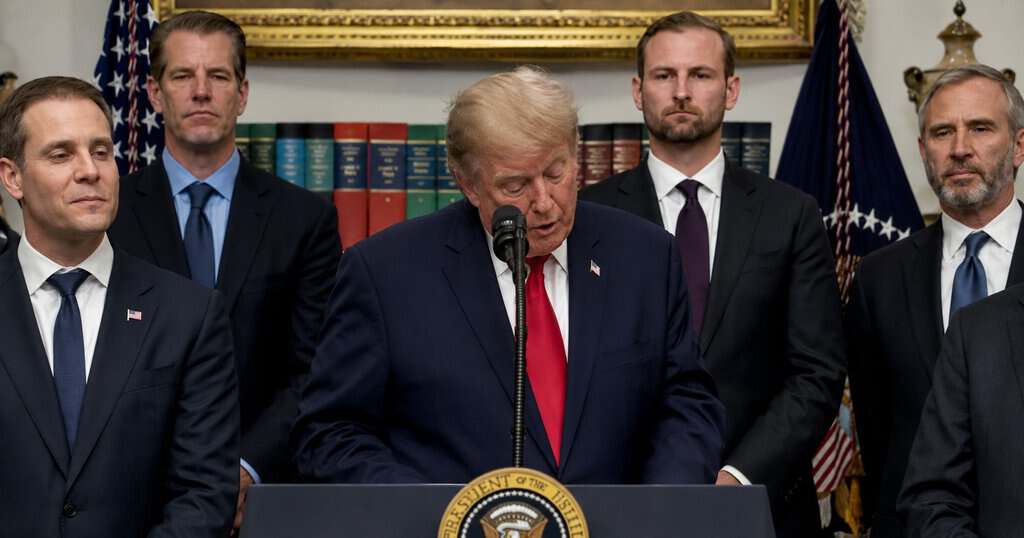
“We’re ensuring that America remains the undisputed leader, not only in Bitcoin and crypto, but also in technologies like prediction markets and artificial intelligence.”
President Donald Trump – Aug. 19, 2026
During a speech at the White House alongside crypto investors, President Trump said the United States must lead the world in several tech-related sectors, including prediction markets, a form of stock-market-style betting.
U.S. prediction-market exchanges operate under federal CFTC regulation and allow betting on many real-world events and outcomes, in areas such as politics, elections, pop culture, and climate. However, so-called sports-event contracts, which numerous U.S. states allege are an unlicensed and illegal form of sports betting operating within their borders, generate much of the betting volume on leading prediction-market platforms such as Kalshi and Polymarket.
According to The Kennedy Forum, these sports-event contracts have accounted for roughly 75-90% of Kalshi’s volume and approximately 50% of Polymarket’s activity.
Prediction markets are, in effect, sports betting platforms with non-sports stuff on the side. Kalshi reportedly is worth about $40 billion as of its latest investment talks, while Polymarket hovers around $20 billion. Both firms are more valuable than the top U.S. sports gambling brands.
While Trump didn’t mention sports betting by name, the link is clear. DraftKings, FanDuel, Fanatics, and Underdog, all traditional sports betting brands, also operate prediction markets.
Some of these platforms have already been blocked or declared illegal in numerous countries. Brazil and Spain have taken action against both Kalshi and Polymarket, while regulators in France, Australia, Colombia, Portugal, Singapore, and several other European countries have blocked or restricted Polymarket as unlicensed gambling.
This regulatory pushback will complicate Trump’s plans for U.S. prediction markets to rule the world.
Why does any of this matter? One core reason is that sports betting carries substantial addiction and financial-harm risks. Sports are emotionally charged and culturally significant across the globe.
The U.S.-based National Council on Problem Gambling, which has received funding from firms such as DraftKings and Kalshi, has cited one study that found 16% of sports bettors met clinical criteria for gambling disorder and another 13% showed some signs of gambling problems. An early 2026 survey found that 60% of U.S. online sports bettors chase their losses, a core sign of a gambling problem.
Americans lost nearly $17 billion to state-sanctioned house-banked sports betting in 2025. They lose many billions of dollars more to other forms of sports betting, including prediction markets, sweepstakes sportsbooks, daily fantasy sports platforms, and offshore, unregulated gambling sites.
Trump’s remarks this week suggest the U.S. government wants to be a global leader in prediction markets as sports betting is becoming their dominant use case. This is a remarkable turn of events. At the start of Trump’s first term, legal online sports betting outside Nevada did not even exist in the U.S.