
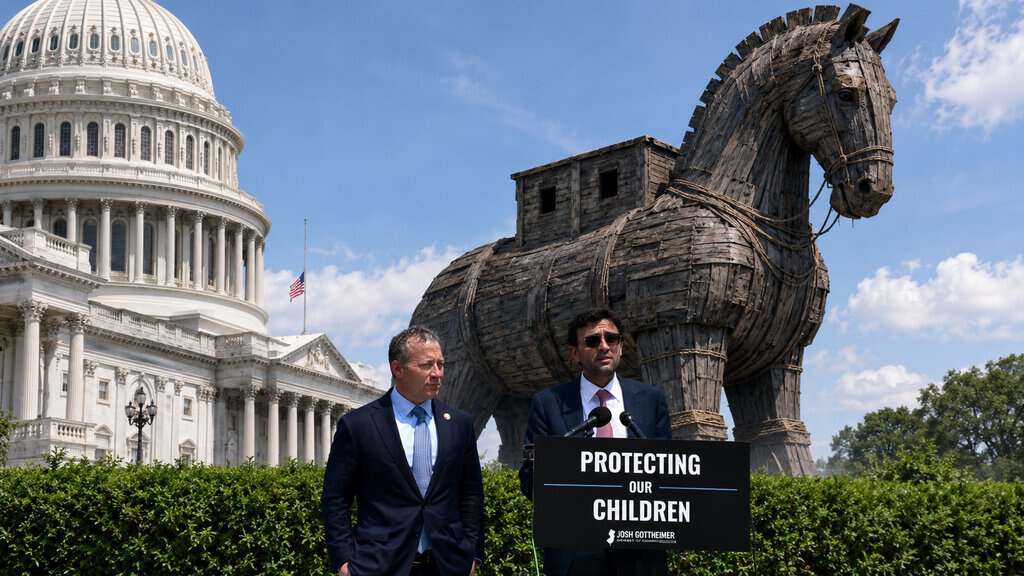
Under the guise of “protecting our children,” a bipartisan group of lawmakers has introduced legislation that, according to a legal expert, could expand online gambling nationwide.
On the surface, H. R. 9706, the “Facial Recognition to Protect Children Act,” would require prediction markets and traditional online sportsbooks to use facial recognition technology to verify a user’s age before they can place a bet. Gambling harm experts say underage online gambling is a real crisis.
However, buried in the legislation is a provision that would benefit the so-called prediction markets, controversial betting platforms that critics and states say facilitate illegal sports gambling.
According to attorney Daniel Wallach, a leading expert in U.S. gambling law, the bill is “deceptively titled” and would tweak existing federal rules to make it easier for the CFTC, the agency critics say regulates prediction markets with only the faintest of touches, to approve products involving “gaming” (i.e., gambling).
Wallach said that the bill’s language “provides an easy backdoor for the CFTC to approve both sports-event contracts AND casino gambling event contracts.”
A press event announcing the legislation hosted Kalshi CEO Tarek Mansour.
The sponsors of the bill are:
- Rep. Jefferson Van Drew (R-NJ)
- Rep. Jimmy Panetta (D-CA)
- Rep. Darren Soto (D-FL)
- Rep. Ritchie Torres (D-NY)
- Rep. Robert P. Bresnahan (R-PA)
- Rep. Kristen McDonald Rivet (D-MI)
- Rep. Nick LaLota (R-NY)
- Rep. Thomas R. Suozzi (D-NY)
- Rep. Bruce Westerman (R-AR)
According to Wallach, each Democrat on the list has received campaign contributions from one of Kalshi’s founders. Kalshi, the dominant player in prediction markets by a wide margin, counts Donald Trump Jr. as a stakeholder.
Some of the bill’s sponsors come from states that are actively fighting prediction markets in court.
GamblingHarm.org Analysis
In its current form, this is one of the most cynical pieces of gambling-related legislation we’ve ever seen. It’s abhorrent to use children as pawns to make it easier for prediction markets or any gambling platforms to expand the reach of their products.
In addition to Kalshi, prediction markets include Polymarket, DraftKings Predictions, and FanDuel Predicts. Only Kalshi was present at the bill’s press event, and it’s unclear if any other betting platform operator supports the bill.
For many months, state and federal courts have been looking at whether so-called “sports event contracts” are legal. Historically, states have regulated gambling. Since 2025, prediction markets have launched peer-to-peer sports betting and argued that it’s not gambling.
With court battles raging, some experts have sounded the alarm that prediction markets may eventually offer a prediction-style version of slot machines, roulette, blackjack, etc. The North American lottery industry has also expressed concern about potential prediction market lottery-style games.
To put it another way: critics fear prediction markets could become online gambling juggernauts under federal, not state, purview. This would deprive states, tribes, and municipalities of gambling tax revenue. In one of the more fiery examples of the bitter legal fight, the City of Detroit described prediction markets as “bloodthirsty leeches.”
It appears that the Facial Recognition to Protect Children Act could help the prediction market sector realize that market potential by clearing red tape to expand online betting.
The stakes are high. In 2025, Americans spent a record $27 billion on state-licensed online gambling platforms. That doesn’t include online lottery products.
Image via Congressman Josh Gottheimer press release, edited with AI.