
The historical parallels between tobacco, primarily cigarettes, and online gambling products are increasingly emphasized these days, as a reform movement grows to rein in sports betting.
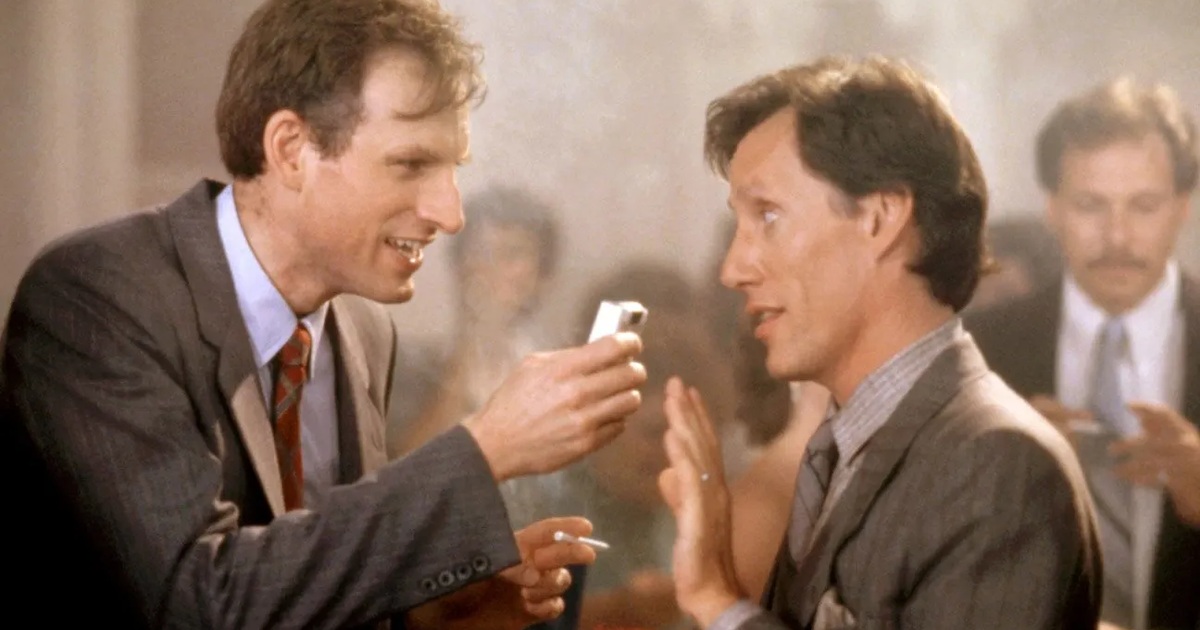
In the spirit of Halloween, I was in the mood for horror-themed portrayals of addiction treatment and/or recovery and stumbled upon the film adaptation of Stephen King’s 1978 short story Quitters, Inc., which later became the first part of the three-story 1985 anthology film Cat’s Eye. I haven’t read the short story, but I watched the 35-minute cinematic version.
You can watch it for free here.
The protagonist, Dick Morrison, played by James Woods, tries to quit smoking by using a “radical” treatment service started by a mob boss who died of lung cancer. In an effort to give back to society in his sick and twisted way, this mafia-inspired addiction treatment business goes to violent lengths to have its clients quit cold turkey.
Whatever It Takes?
Morrison doesn’t realize that when he signs up for the treatment, at a friend’s suggestion, goons will monitor him 24/7, and horrible things happen if he lights up. In this case, though, the violence falls on his family, not him directly—an interesting underscoring of the harm to affected others, which gambling industry arguments frequently marginalize. Big Tobacco did so similarly with second-hand smoke.
The constant surveillance of Morrison in the film seems far-fetched for 1980s technology, but the mafia can apparently pull it off. Perhaps the story was ahead of its time, since dystopian monitoring is quite possible these days. In online gambling, behavioral surveillance and data collection can be used to encourage heavy losses rather than help people stop.
When Morrison eventually caves to a craving and smokes a cigarette while stuck in traffic, a mafia thug is watching from the car next to him, and he rushes home to check on his wife. When he returns to his upper-middle-class house, the treatment clinic’s staff have abducted her and placed her in a room that sends electric shocks through her feet. Morrison is there, held at gunpoint, to witness this torture of his spouse.

In the clinic’s waiting room, he frantically explains to his wife, who earlier expressed support for his desire to quit smoking, that the torture she just endured was part of his treatment. His wife embraces him; they leave the clinic, and Morrison is done with his smoking problem—at least for now.
Later, he returns to the clinic to deal with a small weight gain that the clinic says is normal for people who quit smoking. He seems quite happy to be there again for another appointment. The price for not maintaining his weight? More torture of his wife (this time they’ll cut off one of her fingers). Morrison apparently now regards the clinic’s use of his wife as leverage as an acceptable part of his ongoing self-improvement.
In a sense, he’s stopped smoking, but he may be worse off in other ways. He’s now a loyal customer of the brutal clinic. Still, there’s ambiguity, as Morrison is also a victim of coercion by an unscrupulous mafioso counselor.
The film segment ends with Morrison and his wife, who is somehow doing well after her recent kidnapping and electrocution, having dinner with the friend who initially recommended Quitters, Inc. and the friend’s wife. As they toast the treatment organization, a horrified Morrison notices that his friend’s wife is missing part of her finger.
Deeper Reading
I’m not exactly sure what the deeper moral to this story is. Maybe it’s the question of whether quitting an addictive behavior is necessarily evidence of successful recovery. Morrison stops smoking, but the audience is left questioning what has happened to him morally. How is he letting his wife (and daughter) remain in such danger?
One could also imagine that the extreme stress of coercive treatment makes him vulnerable to a smoking relapse.
With addiction, cultural focus is generally on the individual. In the film adaptation of Quitters, Inc., the story takes this logic to an extreme. The addiction treatment apparently works because Morrison witnesses violence inflicted on his wife by a third party. In this sense, the film can be read as a dark satire of a narrow conception of recovery, where success is measured by whether the individual stops the behavior despite other negative consequences, not to mention the absence of healthier habits.